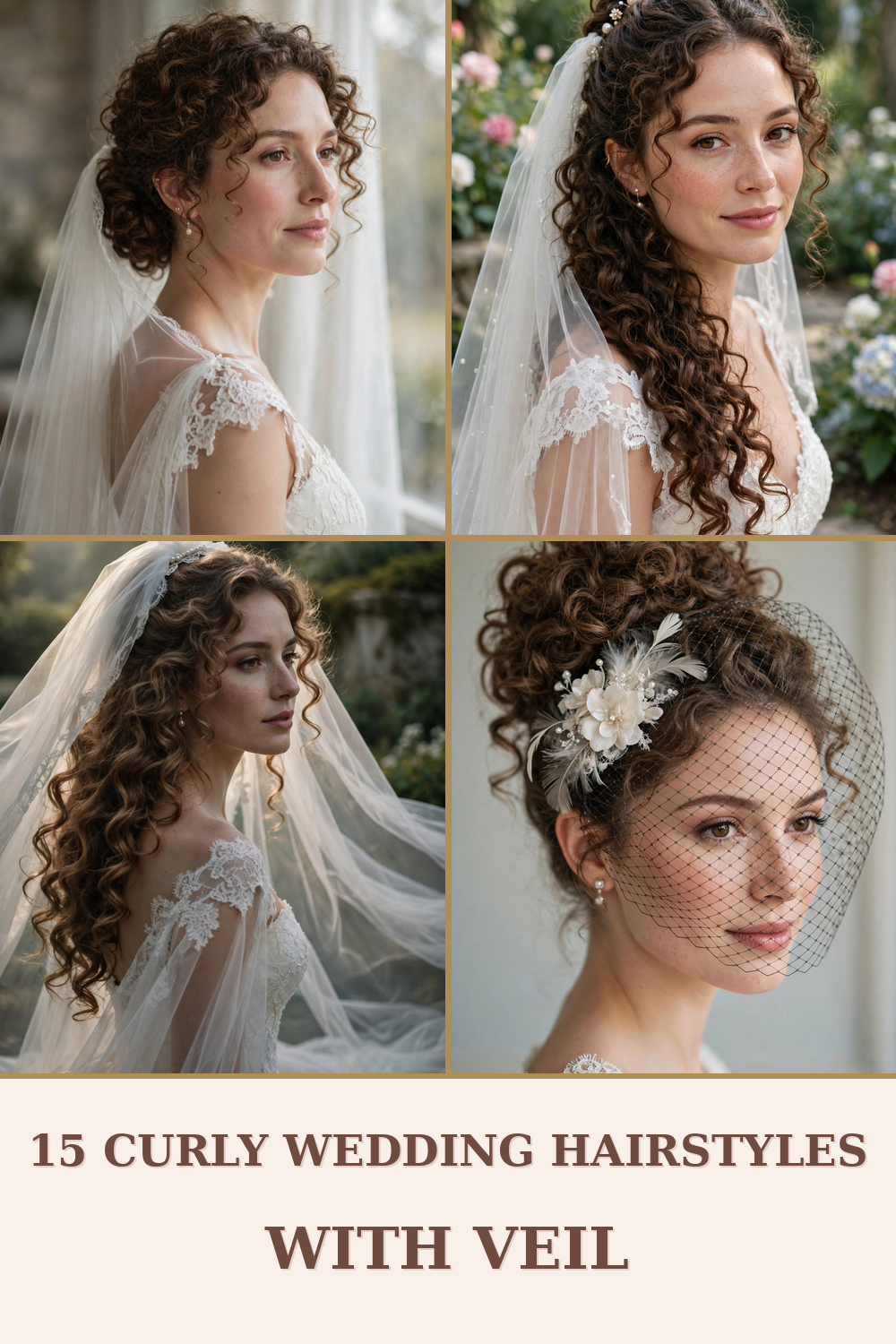
15 Curly Wedding Hairstyles with Veil (2026)
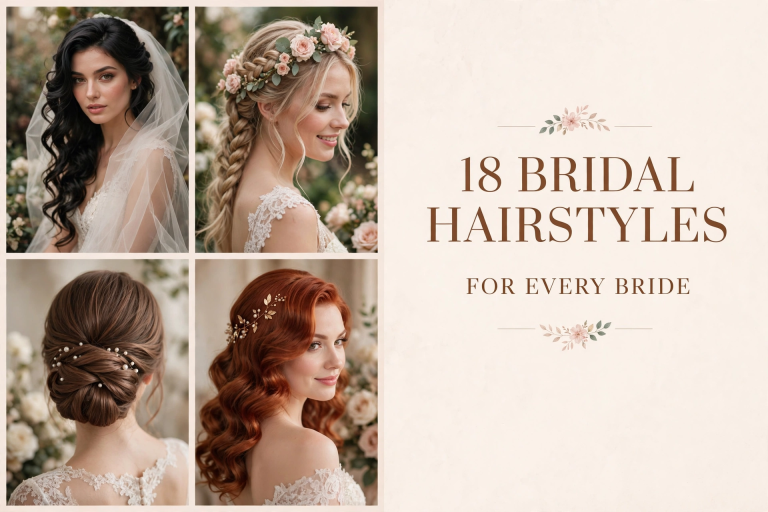
If you have curly hair, you have a secret advantage on your wedding day: your texture grips a veil comb better than any other hair type. No sliding, no slipping — curls give the veil something to hold onto. The trick is knowing where to place the veil and how to anchor it so your curls stay full, defined, and completely unflattened.
This guide gives you 15 curly wedding hairstyles with veil pairings that actually work — each one matched to a specific veil type, with placement instructions your stylist can follow, plus the frizz-proofing, trial, and all-day-hold system that keeps everything perfect from first look to last dance.
Quick Video Tutorial: 3 Steps to a Secure Veil on Curly Hair
Watch: build a pinned anchor, slide the veil comb under it, and cross-pin an X for all-day hold — the exact method used in every style below.
Why Curls and Veils Are a Perfect Match
Straight hair lets veil combs slide right out — stylists have to backcomb, spray, and build artificial “grit” just to keep the veil in place. Curly hair comes with built-in grip. Each curl’s texture catches the teeth of a veil comb, which means:
- Less backcombing and teasing — your volume is already there.
- Fewer pins needed — the comb seats itself into the texture.
- A softer finish — you don’t need a helmet of hairspray to keep the veil up.
The one rule that matters: anchor the veil into a pinned, structured section — never into loose, free-hanging curls. A comb pushed into loose curls will drag them down, stretch them out, and slip by the ceremony. A comb seated into a twist, braid, bun base, or pinned half-up section stays put all day.
The Veil Placement Masterclass (Read This Before Choosing a Style)
Every style below tells you exactly where the veil goes, but here is the system behind all of them. There are four placements, and each creates a different look:
1. Underneath the updo (most popular for curly brides)
The veil comb slides in below the bun or chignon, at the nape. Your curls sit fully on display above the veil — nothing gets covered or flattened. Best for: chapel and cathedral veils, low chignons, twisted buns.
2. Above the updo / at the crown
The veil sits on top of the bun or at the crown, giving that classic lifted, traditional silhouette. Best for: blusher veils (the front layer must fall over your face), high buns, top knots.
3. Into the pinned section of a half-up style
The comb goes into the secured half-up portion — into the twist or braid itself, not the loose curls below. Best for: fingertip veils, half-up cascades, braided crowns.
4. At the crown over loose curls
Yes, you can wear a veil with your curls completely down. The stylist backcombs a small section at the crown, sets two crossed pins as an anchor, and seats the comb into them. Best for: lightweight fingertip or single-tier veils — never a heavy mantilla on loose hair.
Above or under? Underneath shows off your curls; above gives more drama and lift. Neither is “correct” — it’s the silhouette you want in photos.
Veil Types Paired with Curly Styles (The Cheat Sheet)
| Veil type | Length | Best curly pairing | Placement |
| Chapel | ~90″ (floor + train) | Low chignon, twisted bun | Underneath the updo |
| Cathedral | ~108″+ (longest) | Side-swept curls, braided crown | Crown or under updo |
| Fingertip | ~40–45″ | Half-up cascade, low ponytail | Into pinned section |
| Blusher | ~30″ (face layer) | Twisted bun, waterfall braid | Above the updo |
| Birdcage | 9–12″ (face only) | Curly pixie/bob, high bun | Front, with fascinator |
| Mantilla | circular lace veil | Defined wash-and-go curls | Crown, over the hair |
| Juliet cap | cap-style | Curly half-updo | Crown, vintage placement |
| Shoulder | ~20″ | Curly top knot | Just below the knot |
The 15 Styles
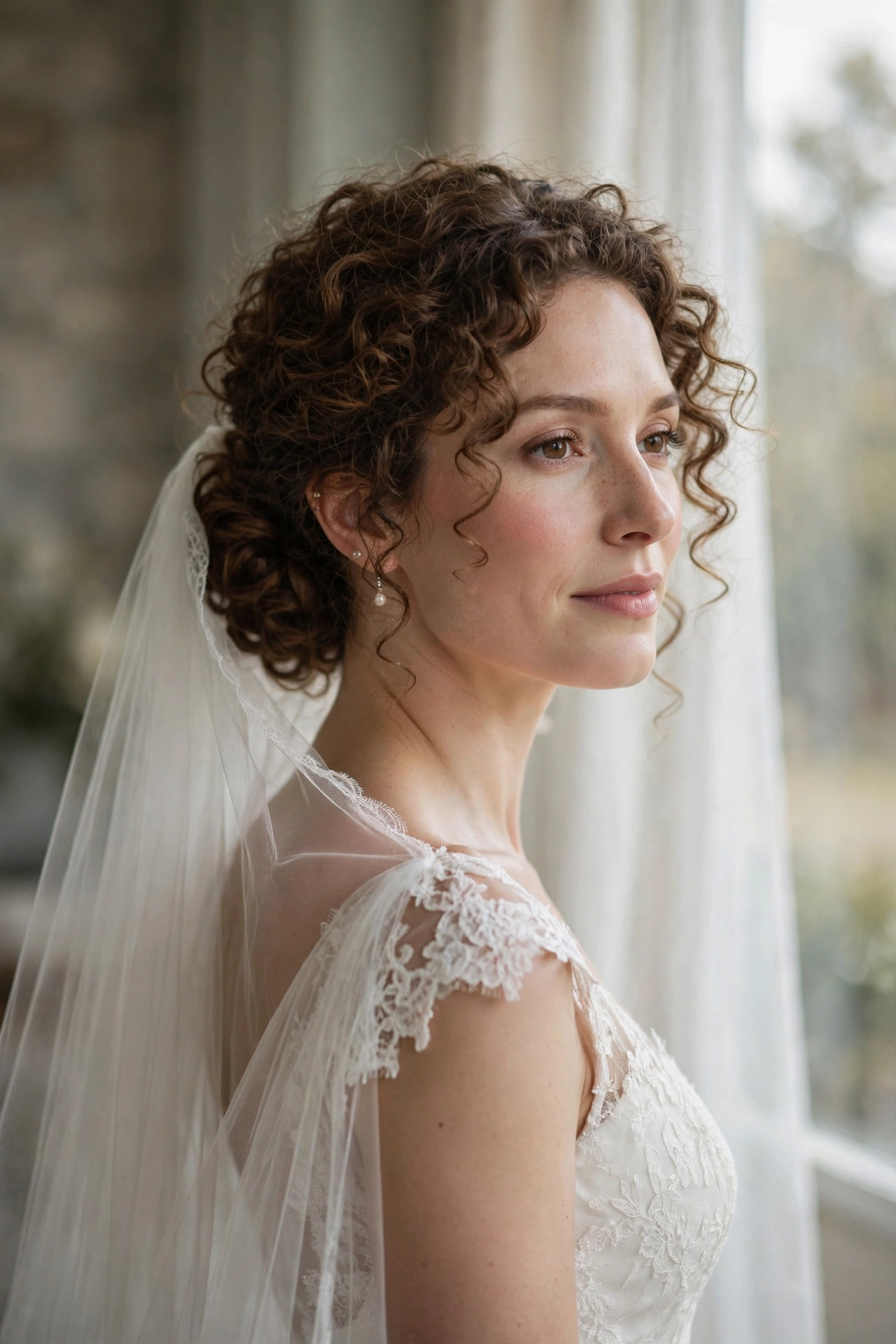
1. Curly Low Chignon with Chapel Veil Underneath
The most requested curly-bridal combination for a reason: timeless, photographs beautifully, and the veil placement is foolproof.
Who it suits: Every face shape; curl types 3A–3C; ideal with strapless, sweetheart, and open-back gowns (the low bun shows off the neckline and back detail). Works for fine curls too — the style builds its own structure.
The veil: Chapel length, comb inserted underneath the chignon at the nape. The veil falls over the train of your dress while every curl stays visible above it.
How it’s built: Curls are defined and fully dry, then loosely gathered at the nape and pinned into a soft chignon — the stylist leaves the curl pattern visible instead of smoothing it. Two crossed bobby pins (an X) form the anchor; the veil comb slides under the X.
All-day hold: Mist the chignon base with flexible-hold spray before pinning. Keep 4 spare pins and a travel hairspray in your emergency kit.
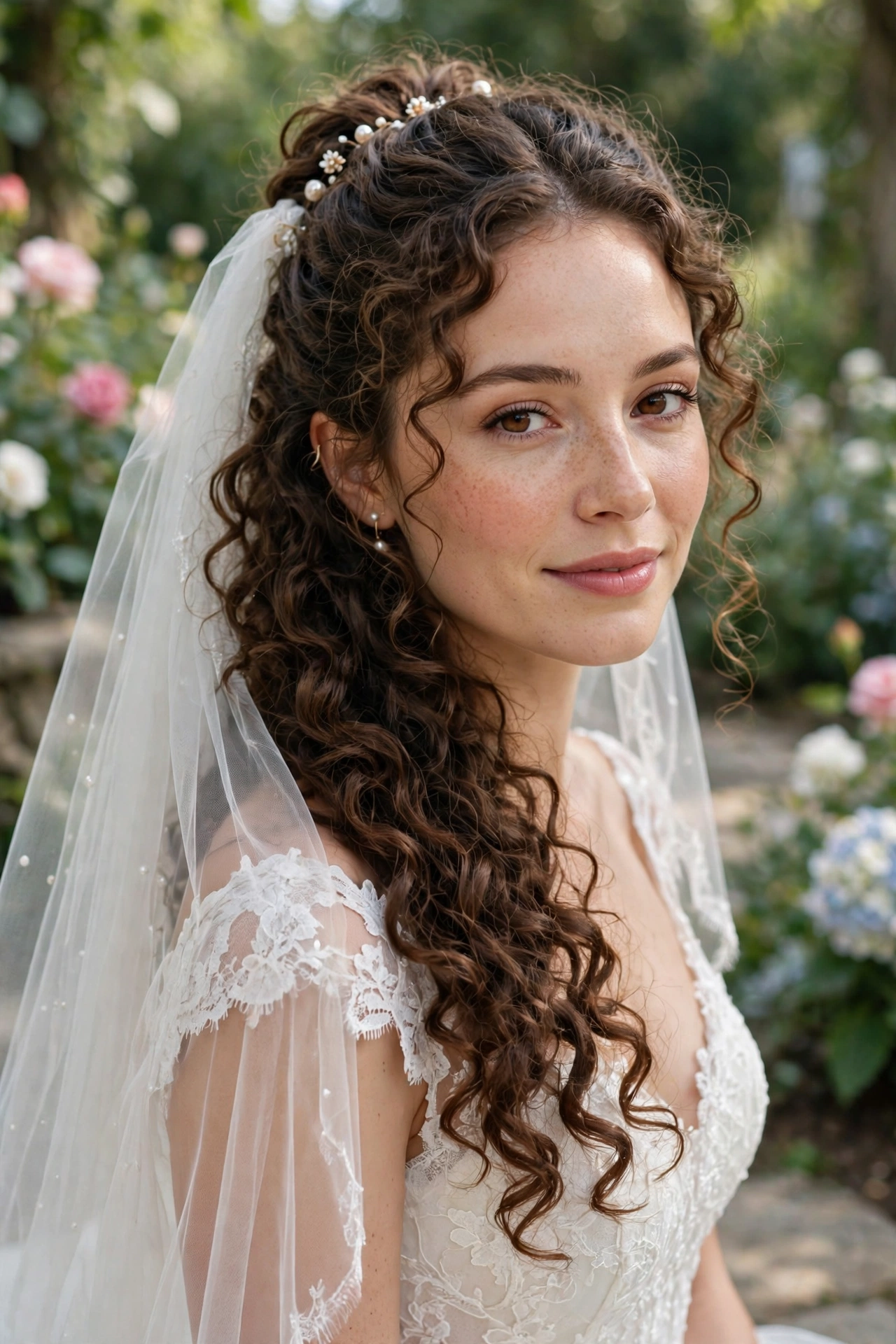
2. Half-Up Curly Cascade with Fingertip Veil
Romance without the fuss — your length and movement stay on full display while the front stays off your face for the ceremony.
Who it suits: Oval, heart, and long faces (the crown lift elongates); medium to long curls, types 2C–3B; pairs with boho, garden, and beach weddings.
The veil: Fingertip length. The comb goes into the pinned half-up section — have your stylist build a small twist or mini-braid as the anchor rather than a plain elastic, which can slip on curls.
How it’s built: The top half is gathered at the crown, twisted once for tension, and pinned. The bottom curls are left completely free and defined with curl cream. The veil comb seats into the twist.
All-day hold: This is the style to test at your trial for wind — loose bottom curls move. A light humidity-resistant spray on the bottom half keeps definition through an outdoor ceremony.
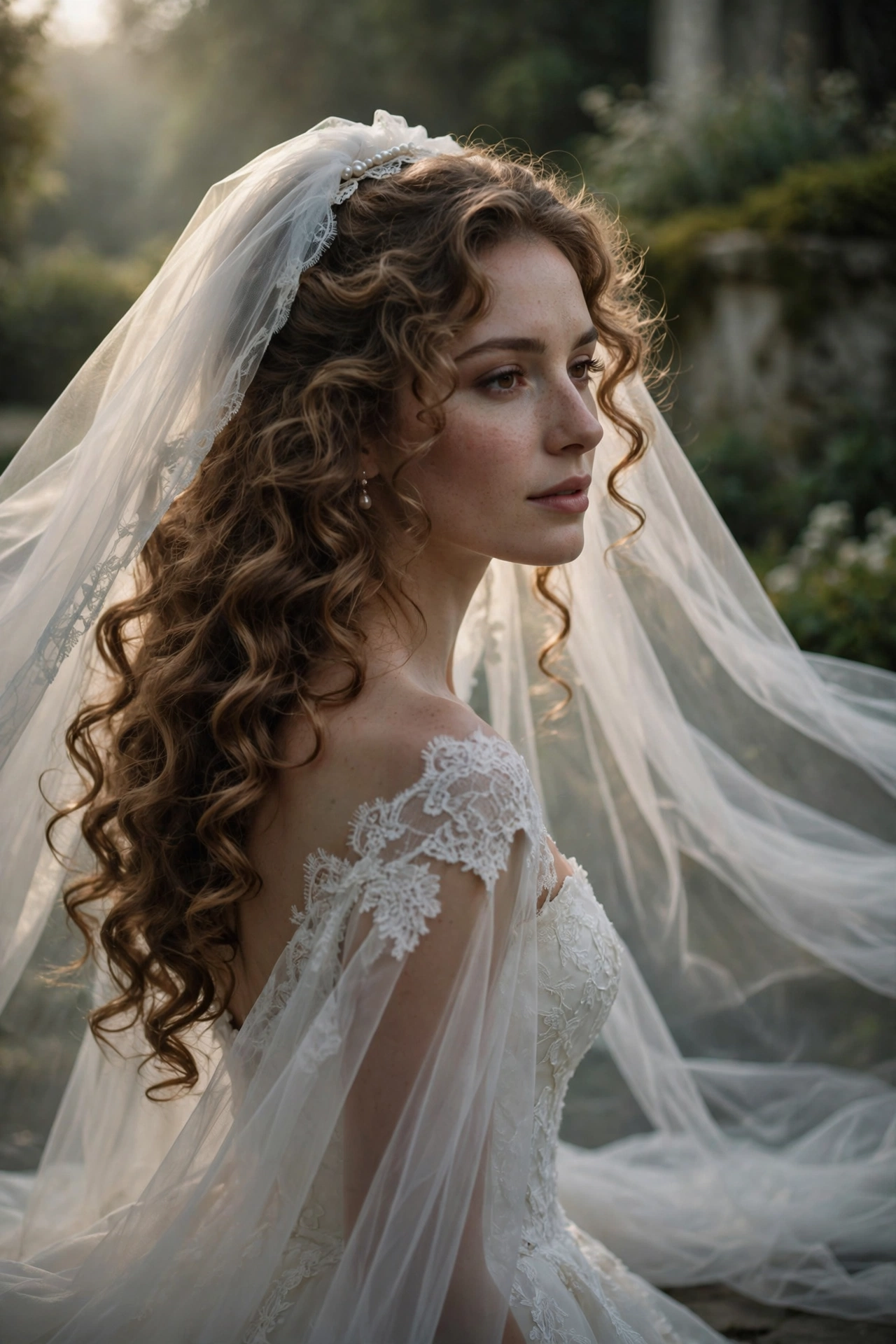
3. Side-Swept Curls with Cathedral Veil
Maximum drama: all your curls pour over one shoulder while a cathedral veil streams behind you. This is the red-carpet bridal look.
Who it suits: Round faces (the asymmetry slims); long, thick curls, types 3A–3C; best with fitted mermaid or sheath gowns — the veil balances the silhouette.
The veil: Cathedral length at the crown, slightly off-center toward the opposite side of the curl sweep. The contrast of curls forward + veil back is what makes this style.
How it’s built: A deep side part, curls swept and pinned loosely over one shoulder with the pins hidden inside the curl mass. The crown gets a small backcombed anchor pad for the veil comb.
All-day hold: The sweep is the failure point — use spiral pins (they grip curls far better than straight bobby pins) and cross two of them at the anchor.
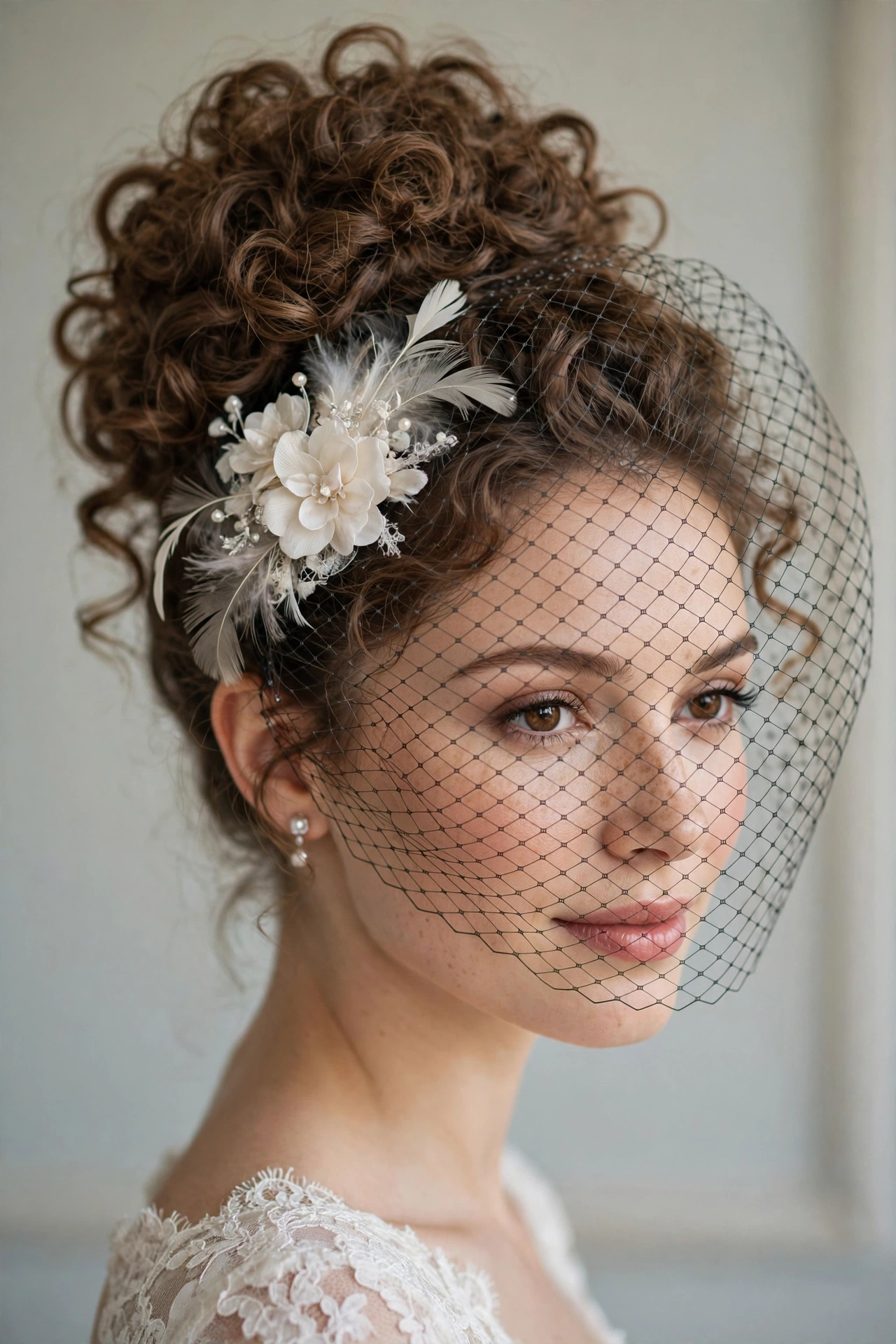
4. Voluminous Curly High Bun with Birdcage Veil
Vintage glamour that shows off your curl texture at its biggest and boldest.
Who it suits: Oval and long faces; thick, high-density curls (types 3B–4A); city, art-deco, and evening weddings; high necklines and halters.
The veil: Birdcage (9–12″), worn at the front with a small fascinator or jeweled clip. It frames the face instead of trailing — perfect when you want the updo fully visible from behind.
How it’s built: Curls are gathered high and pinned into a full, textured bun — volume is the point, so the stylist should not smooth anything. The birdcage attaches at the front hairline with the fascinator as its anchor.
All-day hold: Birdcages are light, so slipping is rare — but the bun is heavy. Anchor the bun itself with at least 6–8 pins in an X pattern before the veil goes anywhere near it.
5. Twisted Curly Bun with Blusher Veil
The traditional ceremony moment — the blusher over your face as you walk in — built on a textured curly bun.
Who it suits: Every face shape; medium-density curls; formal and religious ceremonies where the blusher moment matters.
The veil: Two-tier blusher, placed above the bun (the front tier must fall forward over the face). Comb seats into the top of the bun base.
How it’s built: Sections of curls are twisted and coiled into a bun — the twists add detail that reads beautifully under the sheer blusher layer. The veil comb goes in above the bun, tilted slightly forward.
All-day hold: Practice the blusher flip at the trial — whoever lifts it (partner, parent) should know exactly where the comb sits so they don’t pull the style loose.
6. Curly Top Knot with Shoulder-Length Veil
Modern, minimal, and incredibly secure — the top knot is a natural veil anchor.
Who it suits: Round and square faces (height elongates); all curl types; contemporary venues, courthouse and micro-weddings; pairs with clean, modern gowns.
The veil: Shoulder length, attached just below the knot. Short enough to never tangle in the curls, long enough to read “bridal” in photos.
How it’s built: Curls piled into a high top knot, pinned firmly. The veil comb slides in horizontally right beneath the knot’s base — the knot’s own pins become the anchor.
All-day hold: Nearly bulletproof. The knot’s mass holds the comb; just confirm at the trial that the veil’s weight doesn’t tilt the knot.
7. Waterfall Braid with Curls and Blusher Veil
Bohemian detail meets tradition — the braid frames your head while curls fall free.
Who it suits: Heart and oval faces; long curls, types 2C–3A (the braid shows best on looser curl patterns); rustic, barn, and vineyard weddings.
The veil: Blusher, attached at the front of the head where the braid begins — the braid itself becomes a textured anchor for the comb.
How it’s built: A waterfall braid runs along one side, the remaining curls gather into a low loose bun or fall free. The blusher comb tucks into the braid’s start point.
All-day hold: Braids loosen over hours — have the stylist pancake (gently loosen) the braid at the trial to the exact fullness you want, then set it with spray so it doesn’t expand further during the day.
8. Curly Half-Updo with Juliet Cap Veil
Pure vintage romance — the 1920s-style cap veil was made for texture.
Who it suits: Oval and heart faces; medium curls; Great Gatsby, vintage, and winter weddings; pairs with beaded and art-deco gowns.
The veil: Juliet cap, sitting on the crown like a cap, with the veil falling from its back edge. It distributes weight across the whole head — exceptionally comfortable.
How it’s built: The top half of the curls is gathered loosely at the crown; the cap sits over it. Because the cap covers the crown, the half-up section can be softer and less structured than with a comb veil.
All-day hold: The cap’s even weight distribution means almost no slipping — the easiest veil in this entire guide to wear all day.
9. Defined Wash-and-Go Curls with Mantilla Veil
For the bride who wants to look like herself, only more so — your natural curl pattern, uninterrupted, under a lace mantilla.
Who it suits: Every face shape; types 3B–4C where the natural pattern is the star; Catholic and formal ceremonies (the mantilla is traditional); pairs with lace gowns.
The veil: Mantilla — a circular lace-edged veil worn over the hair, framing the face. It’s the heaviest veil here, so the curls must be fully set.
How it’s built: Your best wash-and-go, executed perfectly: cleansed, deep-conditioned, styled in small sections with leave-in + curl cream + gel, diffused or air-dried completely. The mantilla drapes over the crown and is secured with pins hidden in the curls at the temples.
All-day hold: The mantilla’s weight is the challenge — crossed pins at both temples plus one at the crown. Do the full routine at the trial on the same wash schedule you’ll use on the wedding day.
10. Curly Low Ponytail with Fingertip Veil
Understated, modern, and deceptively secure — the ponytail base is one of the strongest veil anchors there is.
Who it suits: Long faces and strong jawlines (the low placement softens); long curls; minimalist and fashion-forward weddings.
The veil: Fingertip, comb wrapped at the ponytail base. The veil falls straight from the elastic point — clean lines, zero fuss.
How it’s built: Curls gathered low at the nape with a fabric-covered elastic (never bare rubber on curls), the elastic wrapped with a strand of hair. The veil comb slides under the wrapped base.
All-day hold: The ponytail won’t move — the only check is that the veil comb doesn’t slide down the smooth wrapped section. A single crossed pin through the comb and base locks it.
11. Pinned Curly Updo with Chapel Veil (for Fine / Thin Curls)
Fine or low-density curls need a different construction — lightweight products, root lift, and discreet support — but the veil pairing is just as stunning.
Who it suits: Fine strands or low-density curl types 3A–3B; brides who were told “your hair is too thin for an updo” — it isn’t.
The veil: Chapel, underneath the updo. The veil’s own volume visually fills out the silhouette — a trick thin-haired brides should absolutely use.
How it’s built: Root-lifting spray and a light mousse (never heavy creams), curls pinned into a soft, airy updo with small padding at the crown if needed. The veil comb seats into the padded section — padding grips a comb beautifully.
All-day hold: Lightweight everything. Heavy products are what pull fine curly updos down, not the veil. Test the exact product cocktail at the trial.
12. Natural Coils / Afro with Draped Veil
Your texture, celebrated — a shaped afro or defined coils with a softly draped veil.
Who it suits: Types 4A–4C; every face shape; the most striking silhouette in this guide.
The veil: A soft single-tier veil draped from the crown, or a mantilla for formal ceremonies. The veil floats over the shape rather than compressing it.
How it’s built: Coils defined with the bride’s proven routine (twist-out, braid-out, or wash-and-go), shaped into a rounded silhouette. The veil is placed at the crown and secured with long pins driven into the densest part of the hair — coil density holds pins better than any other texture.
All-day hold: Moisture first: a leave-in under the styling products keeps coils from shrinking as the day goes on. The veil adds almost no pull, so this style is exceptionally stable.
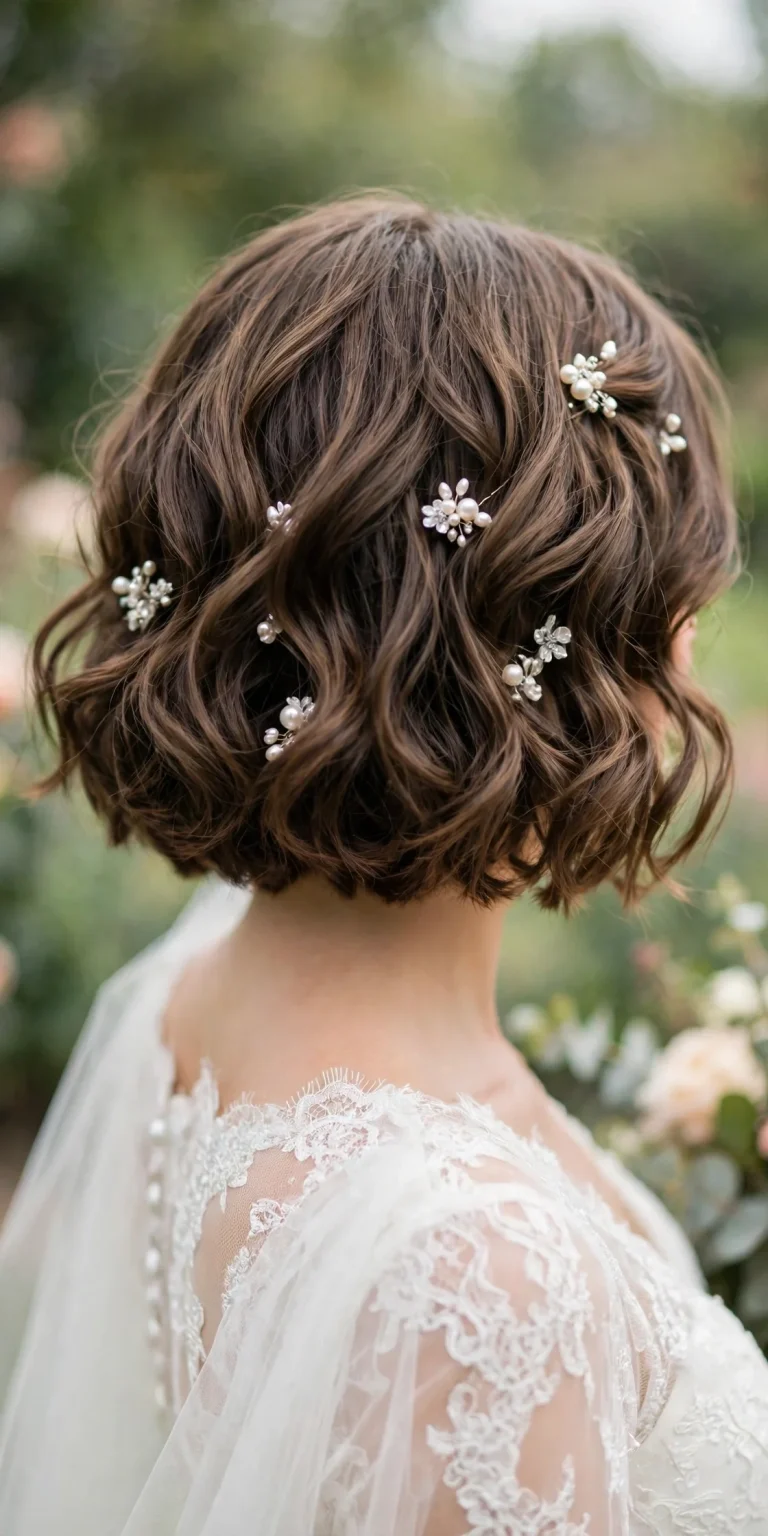
13. Short Curly Bob or Pixie with Birdcage Veil
Short hair brides absolutely can wear a veil — the birdcage was designed for exactly this.
Who it suits: Short curls, curly bobs, tapered pixies; petite brides (a long veil can overwhelm a small frame — the birdcage won’t); modern and elopement weddings.
The veil: Birdcage with a fascinator, comb, or jeweled clip as the anchor. It sits at the front and needs almost no hair mass to hold it.
How it’s built: Curls defined and shaped — a side part or swept fringe gives the birdcage a clean line to sit against. The fascinator pins into the denser side; the birdcage netting attaches to it.
All-day hold: The lightest veil option here. If even a fascinator feels like too much, two jeweled combs crossed at the temple hold a birdcage securely on a pixie.
14. Curly Side Braid with Blusher Veil
Soft, romantic, and photogenic from every angle — the braid keeps curls controlled while the blusher keeps it traditional.
Who it suits: Round and heart faces; medium to long curls; outdoor and daytime weddings.
The veil: Blusher, attached where the braid begins at the crown. The braid’s texture grips the comb.
How it’s built: A loose side braid (Dutch or fishtail) over one shoulder, pancaked for fullness, with curled ends left free. The blusher comb tucks into the braid’s start.
All-day hold: Braids + blushers are a proven combination — just keep the braid loose enough that the comb doesn’t create a visible bump under the sheer layer.
15. Braided Crown with Curls and Cathedral Veil
The most dramatic pairing in the guide: a braided crown circling the head, curls flowing beneath, cathedral veil streaming behind.
Who it suits: Oval faces; long, thick curls; formal evening weddings and ballrooms.
The veil: Cathedral, at the crown just behind the braided crown. The braid frames the veil’s attachment point — in photos, the transition looks seamless.
How it’s built: A Dutch braid circles the head like a crown; the remaining curls fall free below it. The cathedral comb slides in behind the braid, which hides the entire attachment.
All-day hold: This is the heaviest veil in the guide on the most complex style — book the trial, wear it for two full hours, move, hug people, and confirm nothing shifts before the wedding day.
Match Your Curl Type (3A–4C)
- 3A (loose curls): Your curls behave closest to waves — use a light mousse for grip and choose styles with built-in anchors (braids, twists). Veil combs can slip on 3A, so crossed pins are non-negotiable.
- 3B (springy curls): The sweet spot — enough texture to grip any veil, enough definition to wear down. Every style in this guide works.
- 3C (tight curls): Work in small sections and keep the style’s tension comfortable. Dense 3C hair holds veils effortlessly — you can carry a cathedral with confidence.
- 4A–4C (coils): Maximum grip, maximum volume. Your hair holds pins better than any other type — see Style #12. Keep moisture sealed so shrinkage doesn’t change the silhouette during the day.
- Fine/low-density curls (any pattern): Lightweight products only, root lift, and consider the veil itself as a volume tool (Style #11).
Frizz-Proofing for Humid or Outdoor Weddings
Humidity is the curly bride’s real opponent — not the veil. The system:
- A week before: A hydrating mask and your proven wash routine — no experiments.
- Night before or morning of: Style on your tested schedule (most curl brides do better styling the night before and refreshing in the morning — confirm at the trial).
- Layering: Leave-in → curl cream → gel or mousse → (fully dry) → light oil to seal. Each layer thin; too much product weighs curls down and causes frizz faster.
- Finish: A humidity-resistant flexible hairspray — flexible, not stiff. Crunchy curls photograph badly.
- Day of: Hands off once it’s set. Every touch creates frizz. Give your maid of honor the emergency kit, not your hands.
The Hair Trial Checklist (Bring Your Veil)
Never do a trial without the actual veil — a stylist cannot place or weight-test a veil they can’t touch. Bring:
- The veil itself (in its bag, unwrinkled as possible)
- Your headpiece, tiara, or fascinator if wearing one
- Reference photos matching YOUR length, density, and curl pattern (not straight-haired models)
- The neckline of your dress (a photo works)
At the trial, test: the exact placement, the veil’s weight over 2 hours, removal (who takes it out and how), and the style underneath after removal — because of the next section.
Products & Tools Your Stylist Will Reach For
- Sulfate-free cleanser + deep conditioner (prep)
- Leave-in conditioner, curl cream, light gel or mousse (definition)
- Heat protectant (if diffusing), flexible-hold + humidity-resistant hairsprays (finish)
- Light oil or serum (seal and shine)
- Bobby pins matched to your hair color, spiral pins (for sweeps), crossed X-pin anchors
- Fabric-covered elastics, small padding or donut (fine hair)
- A rattail comb (sectioning), diffuser (if part of your routine)
Budget vs. Premium
Budget route: Your proven home routine + a stylist for pinning and veil placement only; drugstore curl cream and flexible spray; a simple single-tier veil. Total styling cost stays low and the result is still secure.
Premium route: A curl-specialist stylist (not a generalist — ask how many curly brides they’ve done), luxury products, a hand-finished mantilla or cathedral veil, and a full trial + day-of booking. Worth it for complex styles (#9, #12, #15) and humid outdoor weddings.
7 Mistakes to Avoid
- Pinning the veil into loose curls — the #1 cause of slipping. Anchor into pinned sections only.
- Skipping the trial with the veil — weight and placement can’t be guessed.
- Washing on a different schedule than the trial — curls behave differently on wash day vs. day three. Match it.
- Choosing a heavy mantilla for loose hair — heavy veils need structured anchors.
- Letting anyone “smooth” your curls flat for the veil — the texture IS the grip. Smoothing removes it.
- Touching your hair all day — every touch is frizz. Hands off after the final spray.
- Forgetting the reception plan — decide now what happens when the veil comes off (below).
When the Veil Comes Off: Your Reception Look
Most brides remove the veil after the ceremony or first dance — plan the reveal, don’t improvise it. Good options:
- Leave the style as-is: Updos (#1, #4, #5, #6, #11) look complete without the veil. Just lift the comb straight out — don’t pull sideways.
- Swap in sparkle: Keep pearl or crystal pins in your emergency kit. When the veil comes out, dot 3–5 pins through the style — it reads as an intentional second look.
- Half-up styles (#2, #8): Fluff the crown gently where the comb sat, smooth with a tiny drop of serum, and you’re done.
- Assign the job: Tell one person (maid of honor, stylist) exactly how the veil removes. A confused tug can undo an hour of pinning.
Pro Tips from Curl-Specialist Stylists
- Cross your pins: Two bobby pins in an X grip curls twice as well as parallel pins. Every anchor in this guide assumes X-pinning.
- Match pin color to your hair — visible silver pins in dark curls ruin close-up photos.
- Spiral pins beat straight pins for side sweeps and heavy sections — they screw into the curl mass instead of sliding.
- Tiara + veil: Place the tiara first, then seat the veil comb just behind it. Test both together at the trial — never add the tiara on the wedding day untested.
- Photography: Tell your photographer which side the veil falls on so they shoot your “curl side” during portraits.
- Wind plan: For beach or open-venue weddings, choose an updo-based style (#1, #4, #6) — loose curls + veil + wind is a three-way fight you’ll lose.
Frequently Asked Questions
Can you wear a veil with curly hair?
Yes — curly hair is actually the easiest hair type to veil. The natural texture grips the veil comb, so it slips less than on straight hair. The key is seating the comb into a pinned section (a twist, braid, or bun base) rather than into loose curls.
Where do you put the veil with curly hair — over or under the curls?
Both work. Under an updo (at the nape) shows off every curl and suits chapel and cathedral veils. Over the crown gives a traditional lifted silhouette and is required for blusher veils. For loose curls, place it at the crown into a small backcombed anchor.
How do you keep a veil from slipping in curly hair?
Seat the comb into a structured, pinned section — never loose curls. Build the anchor with two crossed bobby pins (an X), slide the comb under the X, and add one more crossed pin through the comb’s teeth. Test the exact placement and the veil’s weight at your hair trial.
What veil length works best with curly hair?
Fingertip and shoulder veils are the most forgiving — light enough for any style. Chapel and cathedral veils pair best with updos (the style carries the weight). Birdcages are ideal for short curly hair. Heavy mantillas need a structured style, not loose hair.
Should the veil go under or over an updo?
Under the updo displays your curls fully and keeps the veil from flattening them — the most popular choice for curly brides. Over the updo creates more height and drama and is necessary when wearing a blusher. Choose based on the silhouette you want in photos.
What hairstyles look best with a veil for curly brides?
Low chignons, twisted buns, and top knots give the veil the strongest anchor. Half-up styles work when the comb goes into the pinned section. Defined curls worn down work with lightweight veils placed at the crown. All 15 styles in this guide are veil-tested pairings.
Can you wear a veil with short curly hair?
Absolutely. A birdcage veil with a small fascinator or jeweled clip is designed for short hair — it needs almost no hair mass to stay put. Short curly bobs can also carry a shoulder-length veil pinned at the crown. See Style #13.
What do you do with your hair when the veil comes off?
Plan it in advance: updos look finished without the veil — just lift the comb straight out. For half-up and down styles, keep pearl or crystal pins in your emergency kit to dot through the hair as a “second look.” Assign one person to remove the veil so nobody tugs the style loose.
The Bottom Line
Curly hair doesn’t just tolerate a veil — it’s built for one. Pick a style with a real anchor, match the veil length to the structure, test everything at the trial with the actual veil, and keep your hands off the finished style. Do that, and your curls will look as perfect at the last dance as they did walking down the aisle.