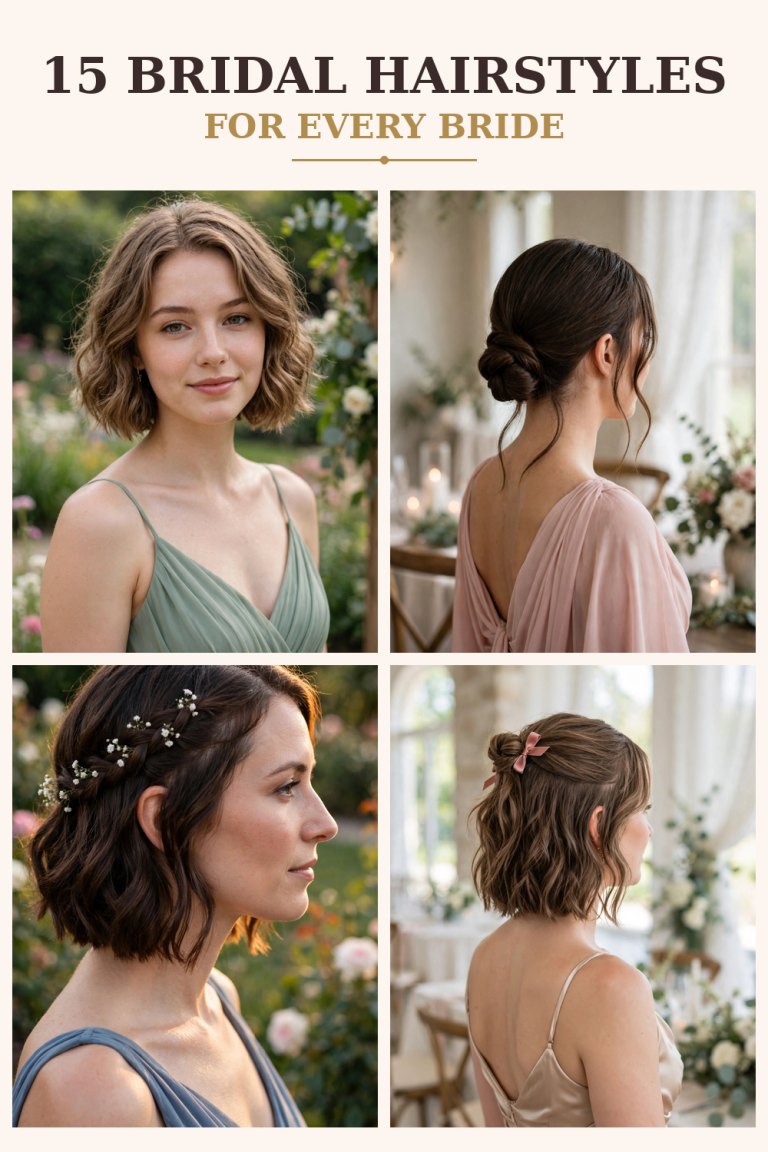
14 Wedding Hairstyles for Short Hair with a Headband (2026)
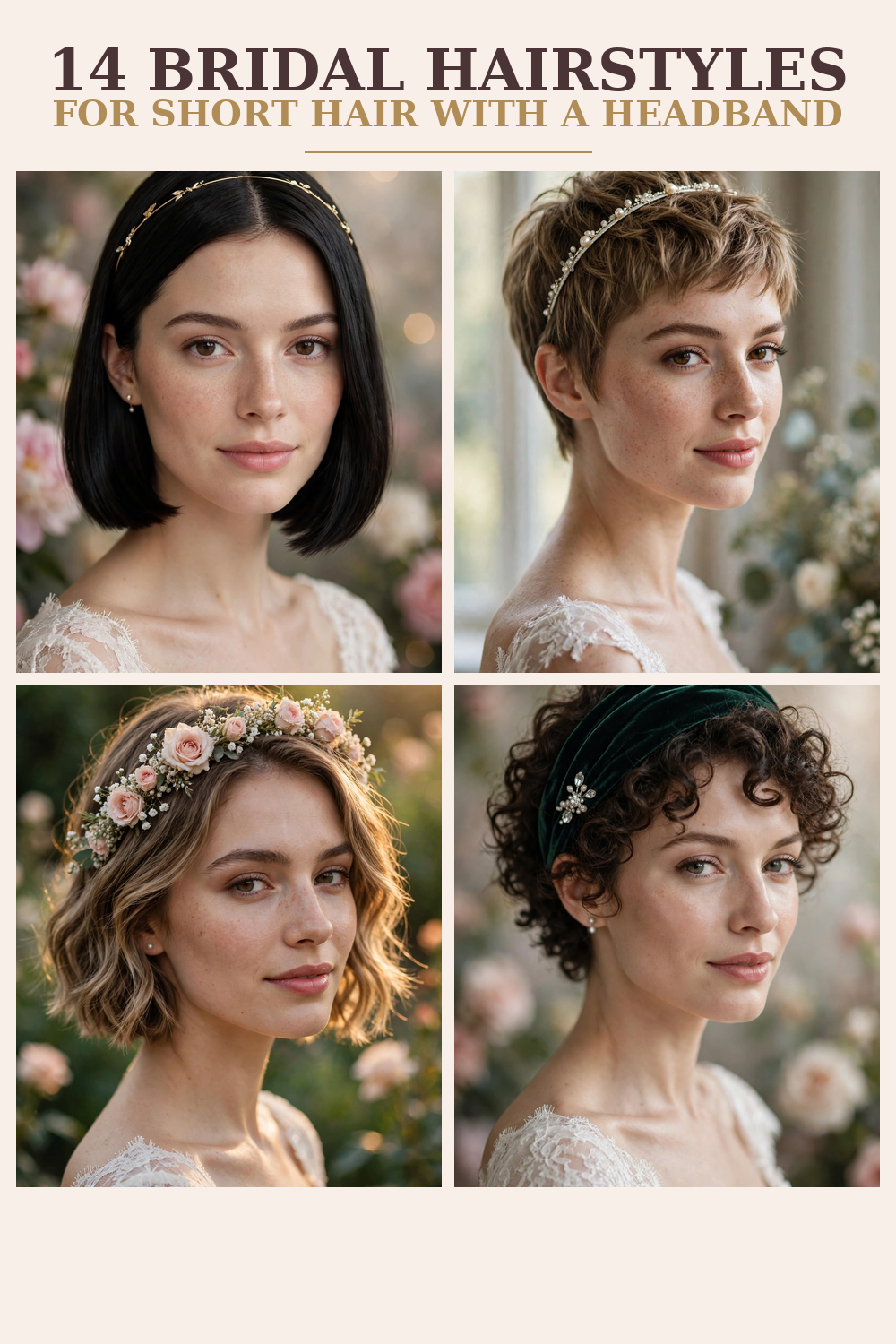
Short hair plus a headband is one of the smartest bridal combinations there is — and it’s criminally under-covered. Most blogs mention “add a headband” in one throwaway line and move on, never telling you which band type suits which cut, where on your head it should sit, or how to keep it from sliding off fine short hair during the first dance.
Here’s the short answer to the question every short-haired bride asks: yes, headbands absolutely work on short wedding hair — pixies, bobs, and lobs included. A headband does the job that extra inches of length normally do: it adds instant bridal polish, frames your face, and gives the camera something to focus on. The trick is matching the band to the cut and anchoring it properly, which is exactly what this guide does.
Below are 14 wedding hairstyles for short hair with a headband for 2026 — each one with the reason it works, step-by-step styling, the exact headband to buy, where it sits on your head, how it stays put on short hair, and what dress and venue it pairs with.
1. Thin Metallic Headband on a Sleek Bob
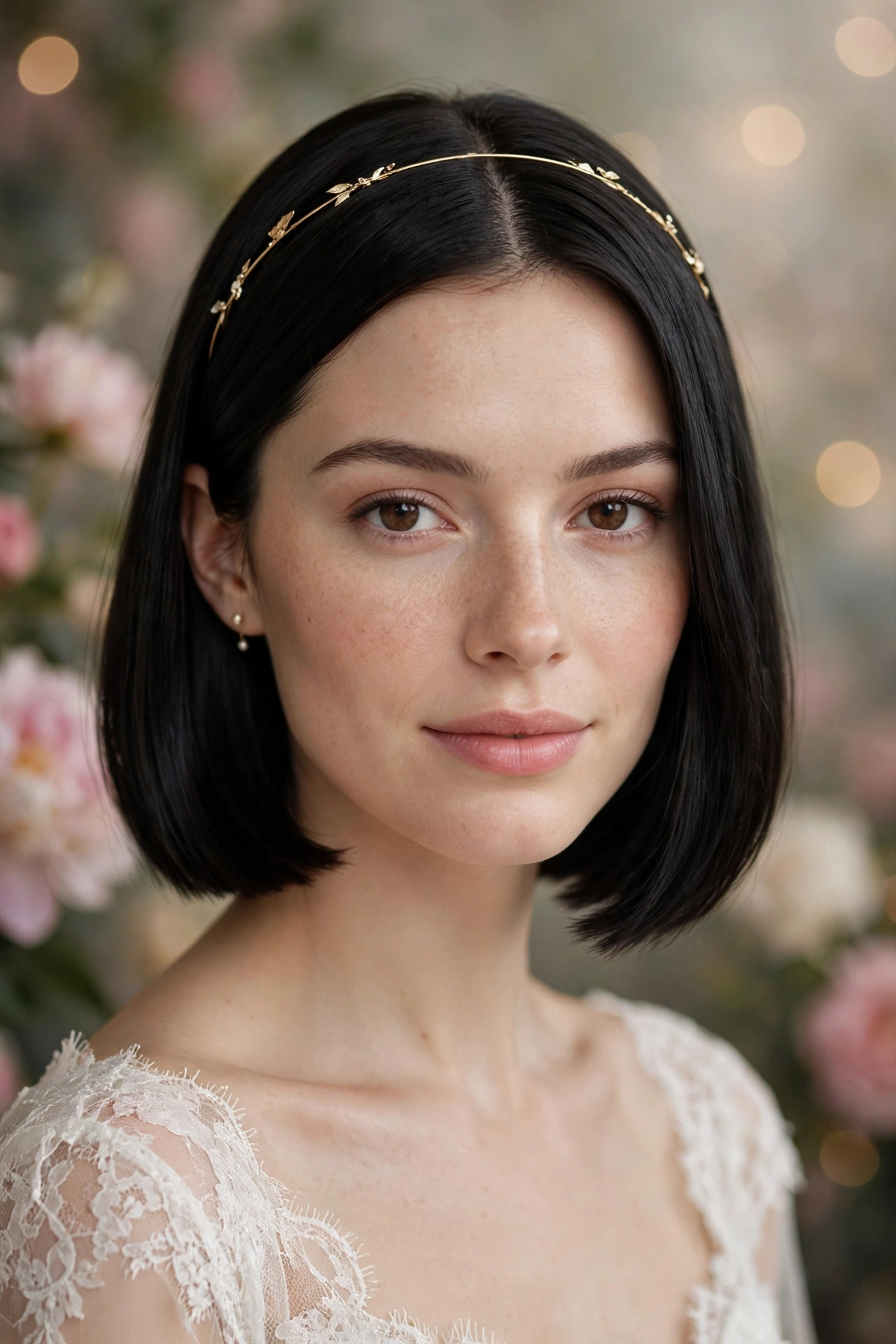
The most foolproof look on this list: a pin-straight, chin-grazing bob parted in the middle or just off-center, with a thin gold or silver metallic band sitting about an inch back from the hairline. The sleekness makes the band the star — it reads as jewelry for your hair — and the narrow band doesn’t swallow a shorter cut the way a wide one can.
How to style it: Blow-dry the bob smooth with a paddle brush, then flat-iron in thin sections for a glass-like finish. Set the headband about an inch behind the hairline — this is the sweet spot where it grips the most hair without pushing the fringe flat against your forehead. Tuck both sides behind your ears to keep the silhouette narrow and let the band’s ends sit against the ears.
You’ll need: Paddle brush, flat iron, shine serum, thin metallic headband (gold for warm undertones, silver for cool), light-hold hairspray.
Best for: Modern minimalist and city weddings, satin slip dresses, courthouse ceremonies.
2. Pearl Headband on a Pixie
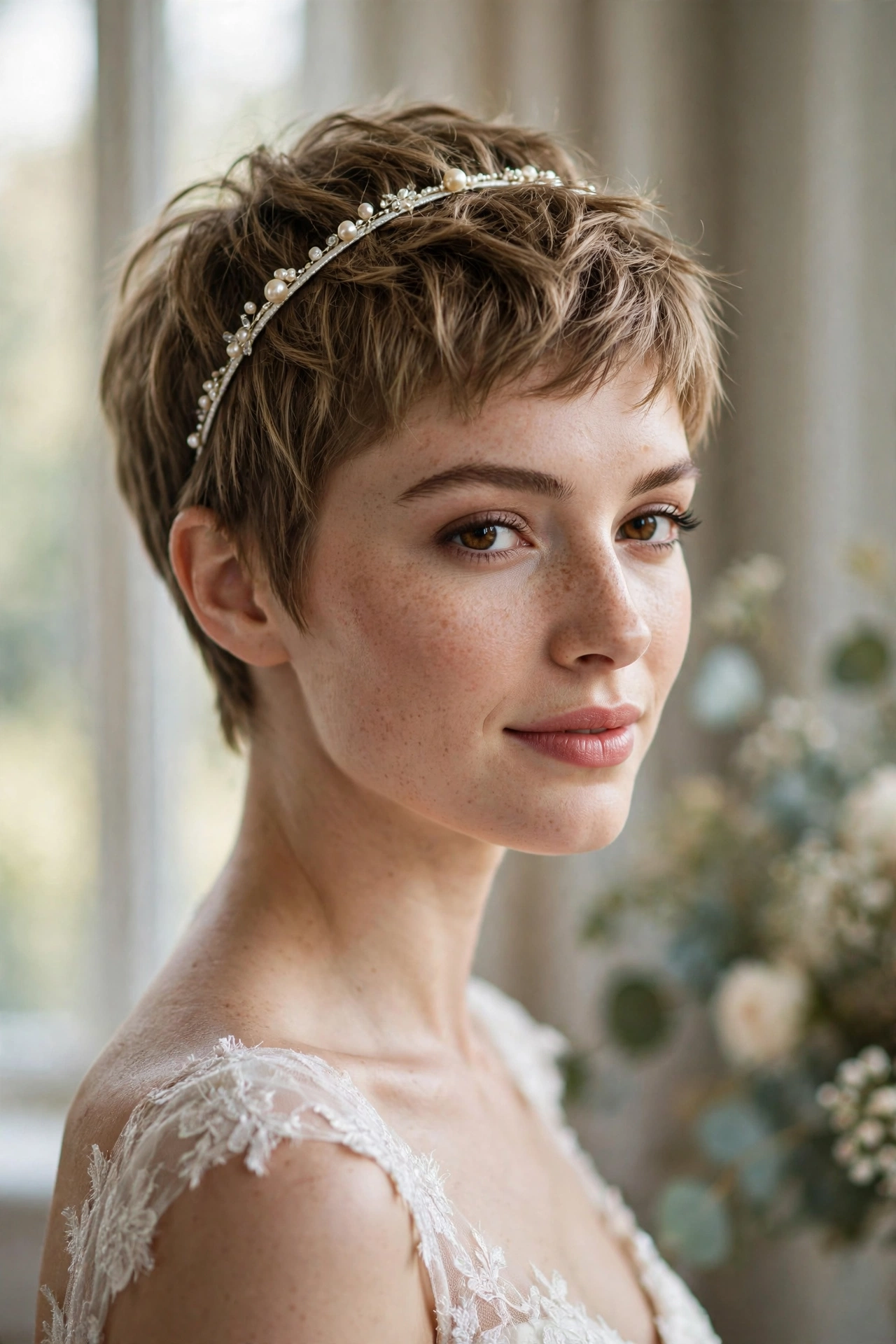
A pearl band is the bridal classic, and on a pixie it works harder than anywhere else — the pearls supply the softness and romance that a cropped cut doesn’t naturally have. Choose a single-row pearl band rather than a chunky multi-row one; scale matters when there’s this little hair, and one delicate row photographs elegantly instead of overwhelming the cut.
How to style it: Add texture cream to the pixie and piece out the top with your fingers for soft separation — don’t over-style it, or the look turns fussy. Slide the pearl band into place at the mid-head (halfway between hairline and crown), then anchor it with two bobby pins crossed in an X at each temple, tucked under the band. The X pinning is what keeps a smooth band on short hair through hugging, dancing, and wind.
You’ll need: Texture cream, single-row pearl headband, bobby pins in your hair color, flexible-hold hairspray.
Best for: Garden and spring weddings, lace and tea-length gowns, romantic vintage themes.
3. Floral Crown on a Wavy Bob
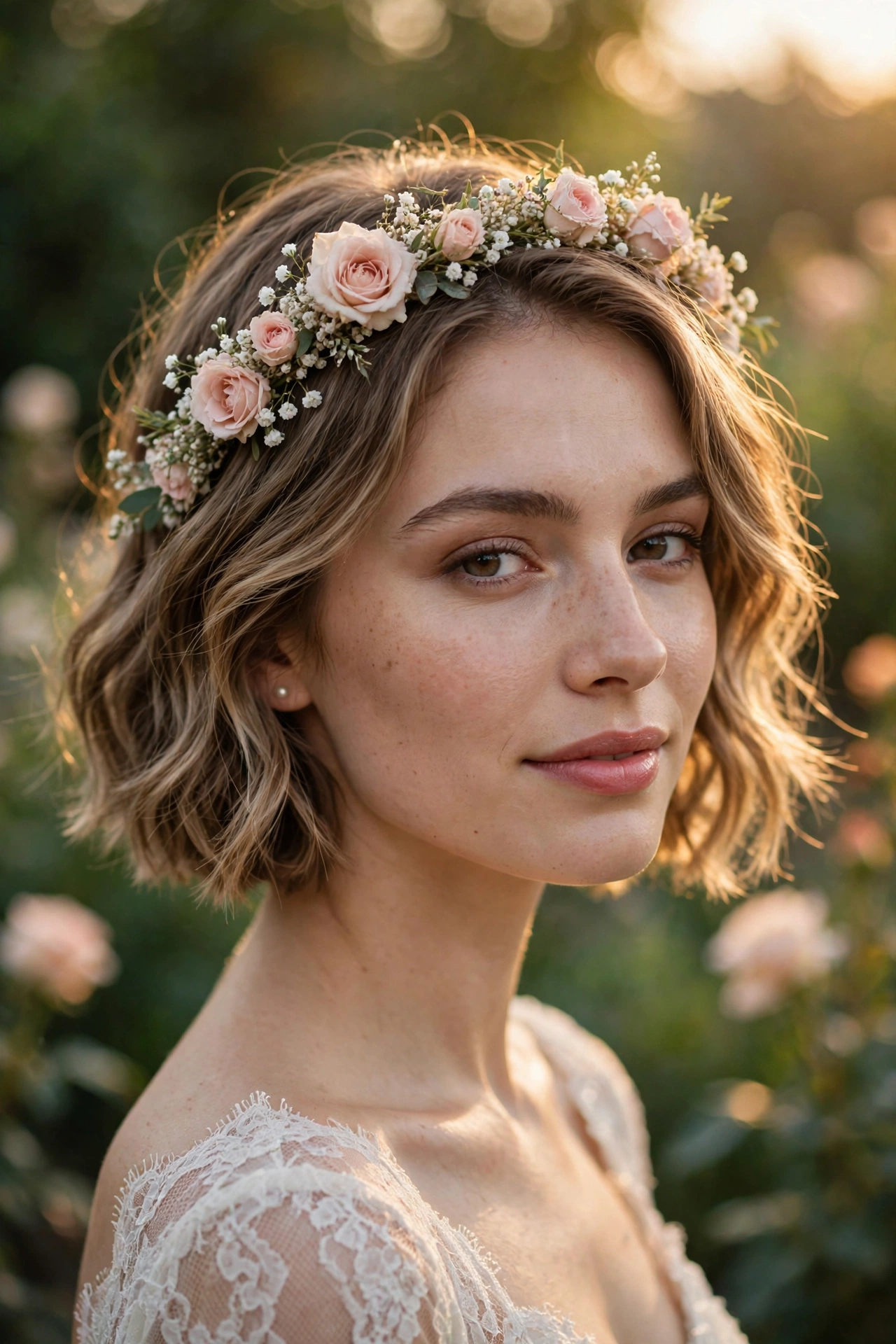
A floral crown headband on a loose wavy bob is the boho bride’s signature — and on short hair it actually looks better than on long hair, because the flowers can’t get lost in a curtain of hair. Go for a crown with smaller blooms (waxflower, baby’s breath, chamomile) rather than giant peonies; oversized flowers on a short cut tip the look from bridal to costume.
How to style it: Wave the bob with a 1-inch curling iron, alternating directions for a natural finish, then break the waves up with your fingers. Set the floral crown so it sits across the crown — further back than a classic headband, almost like a halo — and pin it at both temples plus one pin at the back nape area where the band ends meet the hair. Fresh flowers need to go on last, ideally within an hour of the ceremony; dried or silk versions can go on whenever.
You’ll need: 1-inch curling iron, heat protectant, texturizing spray, floral crown headband (fresh, dried, or silk), bobby pins.
Best for: Outdoor, vineyard, and festival weddings, flowy chiffon or boho gowns, golden-hour portraits.
4. Wide Velvet Headband on Curls
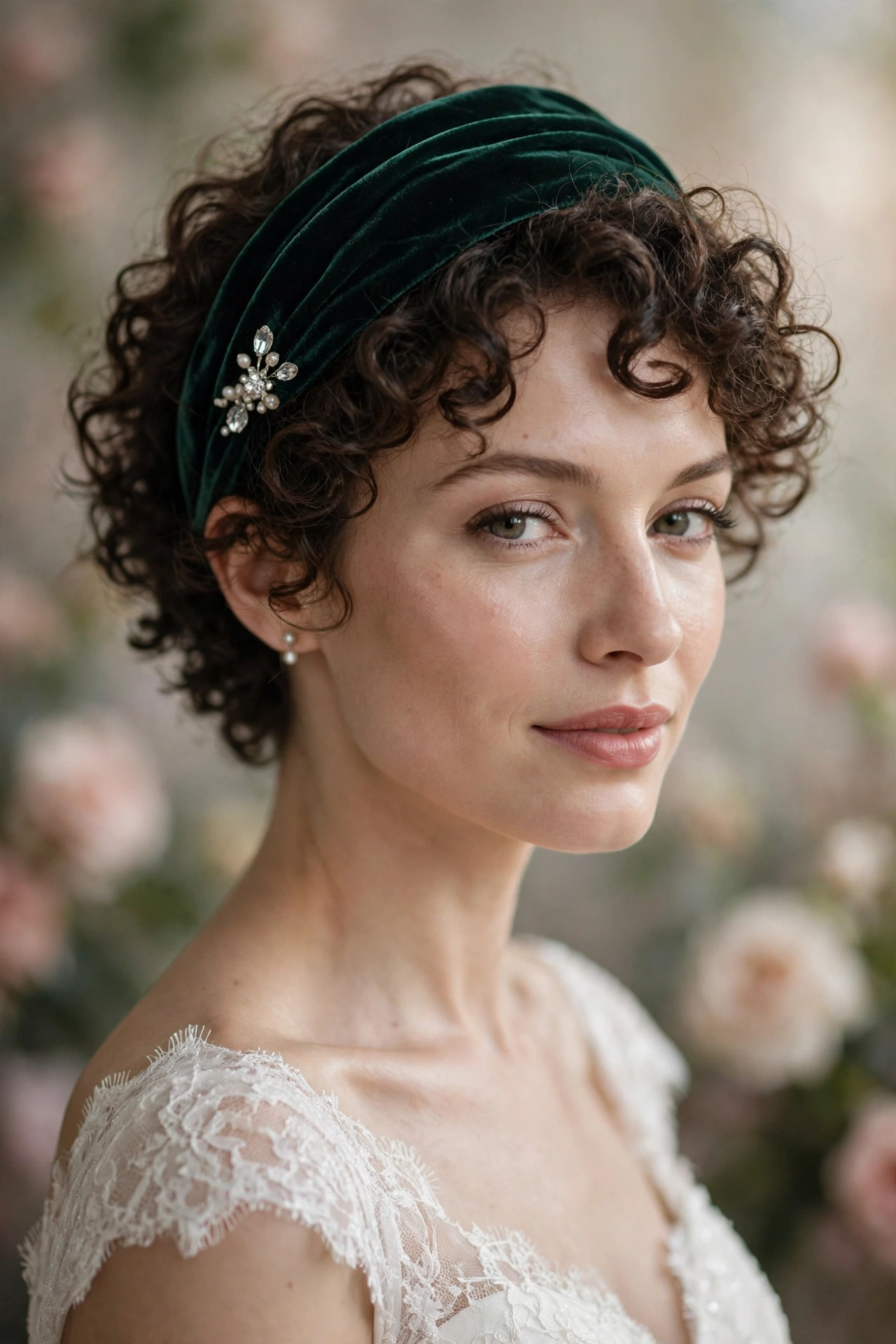
A wide velvet band — deep emerald, burgundy, navy, or classic black — on short curls is pure old-Hollywood-meets-modern-editorial. The velvet’s matte texture grips curly hair naturally (it’s one of the least slip-prone fabrics), and the width of the band balances a voluminous curl shape so the proportions read intentional instead of top-heavy.
How to style it: Define the curls with cream and diffuse upside down for root lift. Push the hair at the front back off the face to create a little crown height, then slide the velvet band on so it sits at the mid-head, letting the curls spring out both in front of and behind it. Velvet grips on its own, so you usually only need one bobby pin per side at the temples — slide them upward under the band so they lock against the direction of slippage.
You’ll need: Curl-defining cream, diffuser, wide velvet headband, 2–4 bobby pins.
Best for: Fall and winter weddings, velvet or satin gowns, moody editorial photography.
5. Double Headband on a Textured Bob
Two thin bands — worn a half-inch apart — turn a simple textured bob into a deliberately styled look. This is a great choice if one band feels like “not enough” but a wide band feels like too much. Keep the two bands in the same finish (both gold, both pearl) so they read as a set, not a mistake.
How to style it: Rough-dry the bob with texturizing spray for lived-in texture. Place the first band about an inch back from the hairline and the second half an inch behind it, both following the same arc. Tease the hair between the bands lightly at the crown for a touch of height, and mist with flexible-hold spray. Pin at both temples.
You’ll need: Texturizing spray, two matching thin headbands, teasing comb, bobby pins.
Best for: Modern art-gallery weddings, minimalist gowns, brides who love clean geometric details.
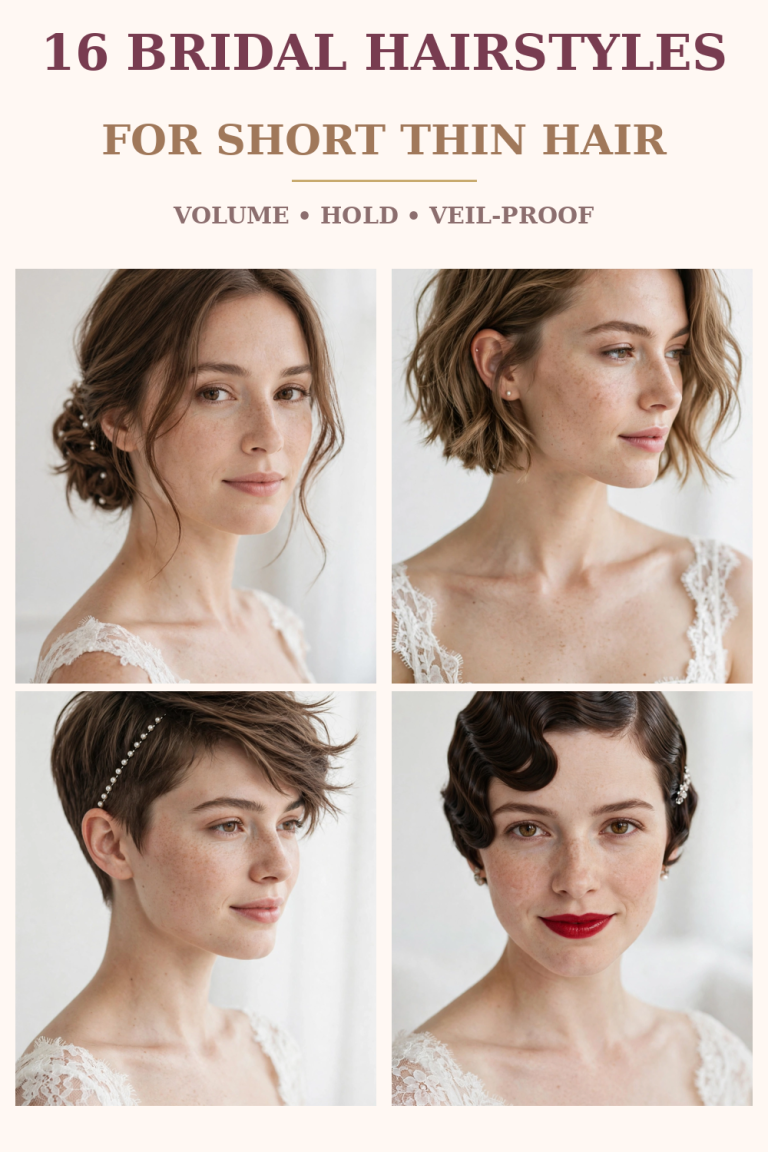
6. Headband with Short Finger Waves
Finger waves plus a headband is vintage glamour at its most precise. The sculpted waves do the visual work, so the band should be quiet — a thin metallic or narrow beaded band. Place it behind the waves, not over them, so the S-curves stay visible.
How to style it: Set damp hair with strong gel using a fine-tooth comb, sculpting S-waves from a deep side part. Let set fully (do not rush this), then slide a thin band in just behind the wave line at the mid-head. Pin at the temples. This is a stylist job — book the trial early.
You’ll need: Strong-hold gel, fine-tooth comb, setting clips, thin metallic or beaded headband.
Best for: Gatsby and vintage-themed weddings, art-deco venues, bold lip looks.
7. Beaded Boho Headband with a Textured Lob
A beaded or embroidered boho band on a textured lob (the longer end of “short”) bridges casual and bridal. The beads catch the light in photos while the texture keeps everything effortless. Wear it across the forehead-boho style or at the mid-head for a more classic read.
How to style it: Add sea-salt spray to damp hair and scrunch-dry for beachy texture. For the classic placement, slide the band to the mid-head and pin at the temples; for boho placement, wear it across the forehead and let the front pieces fall over it. Mist with flexible-hold spray.
You’ll need: Sea-salt spray, beaded boho headband, bobby pins, flexible-hold spray.
Best for: Beach and desert weddings, two-piece or separates bridal looks, barefoot ceremonies.
8. Headband + Birdcage Veil Combo
The headband does double duty here: it’s the styling piece AND the veil’s anchor. A birdcage veil’s comb or clips attach behind the band at the crown, so the band frames your face while the netting falls over it. Choose a band with some structure (padded or wired) since it carries the veil’s weight.
How to style it: Style the short hair smooth or with soft waves. Anchor the headband at the mid-head with X-pinned bobby pins — it must be rock solid. Clip the birdcage veil’s comb into the hair at the crown just behind the band, and let the netting drape forward over the face. Do a full movement test: shake your head, bend forward — the band and veil should move as one.
You’ll need: Structured (padded or wired) headband, birdcage veil, bobby pins, strong-hold spray.
Best for: Retro and vintage-inspired weddings, tea-length dresses, city-hall ceremonies.
9. Ribbon and Scarf Headband
A silk ribbon or scarf tied as a headband is the budget hero of this list and one of the most photogenic options. Tie it in a bow at the top, at the nape, or off to one side for asymmetry. It works on every short cut from pixie to bob because the tie is adjustable — no sizing anxiety.
How to style it: Fold a silk scarf into a 2-inch-wide band. For the classic look, center it at the mid-head and tie a bow on top; for a softer look, tie at the nape and let the ends trail. Tuck the scarf’s edges under with two bobby pins per side. Spritz the knot with a little hairspray so it holds its shape.
You’ll need: Silk scarf or ribbon (at least 30 inches), bobby pins, light-hold hairspray.
Best for: Budget-conscious brides, retro and pin-up themes, second-look reception hair.
10. Crystal Tiara-Style Headband
For maximum bridal impact on minimal hair: a crystal tiara-style band with height at the front. The upward line of the tiara adds verticality that short hair alone can’t give, and the crystals do all the talking — keep the rest of the styling simple so nothing competes.
How to style it: Smooth the hair with serum for a clean base — frizz fights the tiara’s polish. Set the tiara at the crown (further back than a standard headband) so it reads as a tiara, not a headband. Anchor with two pins at each temple plus one at the nape. Keep earrings small; the tiara is the jewelry.
You’ll need: Smoothing serum, crystal tiara-style headband, bobby pins, shine spray.
Best for: Formal ballroom weddings, princess-style gowns, evening ceremonies.
11. Headband with a Low Mini-Updo
Even very short hair can fake a mini-updo: pin the sides and back up into a low tucked shape at the nape, then lay a headband over the top to hide the pinning. The band is camouflage and crown jewel in one — guests see a polished updo with a beautiful band, never the scaffolding underneath.
How to style it: Tease the crown lightly for grip. Twist small sections from each side toward the back and pin them low at the nape, tucking ends under. The shape will look rough — that’s fine. Slide a medium-width embellished band over the mid-head; it covers the transition line between the tucked hair and the top. Mist everything with strong-hold spray.
You’ll need: Teasing comb, bobby pins, medium-width embellished headband, strong-hold spray.
Best for: Brides who want an “updo” without the length, church weddings, classic satin gowns.
12. Padded Statement Headband with a Slicked Pixie
A padded statement band on a slicked-back pixie is the fashion-editor’s bridal look: severe, sculptural, and unforgettable in photos. The padding gives the band presence so it balances the strong silhouette of slicked hair. This is a confident look — it demands a bold lip and clean makeup.
How to style it: Work strong-hold gel through damp hair and comb everything back and flat. Slide the padded band on at the mid-head — it should sit ON the hair, not dig in. Because slicked hair is slippery, this is the one style where you pin generously: three pins per side, woven through the band’s underside. Finish with high-shine spray.
You’ll need: Strong-hold gel, fine-tooth comb, padded statement headband, bobby pins, shine spray.
Best for: Fashion-forward weddings, architectural venues, minimalist slip dresses.
13. Headband with a Braided Front Detail
A tiny braid along the front hairline — even on short hair — plus a headband behind it creates a layered, intricate look from two simple elements. The braid gives texture at the hairline; the band gives polish at the mid-head. Together they look far more complex than either alone.
How to style it: From a side part, take a 1-inch section at the front and do a tight 3-strand braid back along the hairline, pinning the end behind the ear. Repeat on the other side if you like symmetry. Slide the headband in at the mid-head behind the braids and pin at the temples. Pull a few face-framing pieces loose in front of the band for softness.
You’ll need: Small clear elastics, thin embellished headband, bobby pins, texturizing spray.
Best for: Romantic garden weddings, boho-luxe themes, brides who love detail.
14. Embellished Headband with Tousled Curls
An embellished band (crystals, pearls, or beading) on tousled short curls is the “effortless but expensive” look. The curls supply romance and movement; the band supplies the bridal signal. The contrast between undone texture and precise embellishment is what makes it photograph so well.
How to style it: Curl with a 1-inch iron in alternating directions, then rake through with your fingers — do not brush. Set the embellished band at the mid-head and pin at the temples with X-crossed pins. Let a few curls fall in front of the band at the temples for that undone finish. Mist with flexible-hold spray.
You’ll need: 1-inch curling iron, heat protectant, embellished headband, bobby pins, flexible-hold spray.
Best for: Vineyard and estate weddings, romantic lace gowns, golden-hour portraits.
How to Choose the Right Bridal Headband
Match the band to four things: your cut, your face shape, your dress, and your venue. Short pixie? Go delicate — a wide band will swallow the cut. Bob or lob? You can carry more width and embellishment.
- Face shape. Round faces: choose a band with height — a tiara-style or padded band worn at the crown adds vertical lines (see our wedding hairstyles for round face short hair guide). Longer faces: a wider band worn lower, near the hairline, shortens the face visually. Heart-shaped faces: keep embellishment at the sides, not the center, to avoid emphasizing a narrow chin.
- Dress neckline. Strapless and sweetheart necklines can carry a statement band; high necklines and halters pair better with delicate bands so the eye isn’t pulled in two directions.
- Wedding theme and season. Velvet for fall/winter, florals for spring/summer garden weddings, pearls for classic and timeless, crystals for formal evening affairs.
- Hair texture. Fine, slippery hair needs bands with teeth, velvet backing, or silicone grip strips. Thick or curly hair holds almost any band with minimal pinning.
Headband + Veil Rules
Yes, you can wear both — but placement is everything. The two most common mistakes are stacking them at the same spot (they fight all day) and choosing a band too flimsy to anchor the veil.
- Long veil + headband: anchor the veil’s comb at the crown behind the headband, so the band frames the face and the veil falls from behind it. Never stack them at the same spot — they’ll fight each other all day.
- Birdcage veil + headband: clip the veil behind the band as in style #8 above — the band becomes the veil’s anchor.
- Blusher veil: wear the band at the mid-head and let the blusher fall from a comb placed just behind it.
- No veil at the ceremony, veil for photos: choose a band with a flat profile so the veil comb slides in behind it without a bump.
How to Keep a Headband from Slipping All Day
Short hair is slippery territory for headbands — less hair means less grip. These are the pro mechanics that keep a band locked from ceremony to last dance:
- Create a grip base. Mist texturizing spray or root powder on the hair where the band will sit before placing it. This is the single most effective trick.
- X-pin at the temples. Cross two bobby pins in an X over the band at each temple, tucked under the band’s edge. Pins in your exact hair color disappear.
- Pin against the slip direction. Bands slide forward on short hair; slide your pins in pointing backward so they lock against the movement.
- Choose grippy bands. Velvet backing, inner teeth, or silicone strips beat smooth metal every time on fine hair.
- Do the movement test. Shake your head side to side, bend forward, hug someone — if the band shifts in the trial, it will shift at the wedding.
7 Mistakes to Avoid
- Wearing the band at the hairline like a 1970s headband. An inch or two back reads bridal; right at the hairline reads retro-casual.
- Choosing a band wider than your cut can carry. On a pixie, anything over an inch wide starts to look like a costume.
- Skipping the trial. Bands sit differently on styled versus unstyled hair — always trial the exact band.
- Trying a new band on the wedding morning. Bands sit differently on styled versus unstyled hair — trial the exact band you’ll wear.
- Forgetting the back view. Guests and the photographer see the back of your head all ceremony — make sure the band’s ends and pins are clean from behind.
- Matching the band to the dress instead of the hair. The band lives in your hair; match it to your cut and coloring first, dress second.
- No emergency kit. Pack 6 extra bobby pins, a mini hairspray, and a small mirror in the bridal clutch.
Budget vs Premium: What to Buy
Headbands are one of the few bridal accessories where budget options genuinely compete — the difference is mostly in materials and longevity, not looks.
| Item | Budget pick | Premium pick |
|---|---|---|
| Pearl headband | Faux-pearl band, drugstore or fast-fashion ($8–15) | Hand-strung freshwater pearl band ($40–80) |
| Crystal headband | Rhinestone band with metal base ($12–25) | Hand-set crystal band, e.g. Etsy bridal designers ($60–150+) |
| Velvet headband | Plain velvet band ($6–12) | Padded designer velvet band ($30–60) |
| Floral crown | Silk-flower crown ($10–20) | Fresh-flower crown from your florist ($50–120) |
| Bobby pins | Matte drugstore pins | Salon-grade pins matched to your hair color |
| Texturizing spray | Drugstore dry texture spray | Salon sea-salt or root-powder spray |
Trial-Day Tips
- Bring the exact headband to the trial — not a similar one. Width, weight, and grip all change the result.
- Wear the band for at least two hours at the trial, including a movement test.
- Photograph the back and sides, not just the front — that’s what the ceremony sees.
- Test the band with your veil if you’re wearing one.
- Ask your stylist to show you the pinning so your maid of honor can do emergency fixes.
5 Pro Tips from Bridal Stylists
- Tease before you band. A light tease at the crown where the band sits gives it something to grip — then smooth the top layer over so the teasing is invisible.
- Second-day hair holds better. Freshly washed hair is the slipperiest; day-old hair (or dry shampoo) grips bands far better.
- Match metals to your jewelry. Gold band with gold jewelry, silver with silver — mixed metals look accidental in close-up photos.
- One statement at a time. Statement band means quiet earrings; statement earrings mean a quiet band.
- Anchor the veil to the band, not the hair. Sew two small loops of thread on the band’s underside and hook the veil comb through — it will not move all day.
Frequently Asked Questions
How do I wear a headband with short hair without it looking childish?
The childish read comes from three things: a band sitting right at the hairline, a wide plastic band, and overly sweet styling. Fix all three: push the band an inch or two back, choose metal/pearl/crystal/velvet over plastic, and keep the hair itself polished — sleek, waved, or textured. A headband on a sharp bob reads as jewelry, never as a schoolgirl look.
Where should a bridal headband sit — at the hairline or further back?
Further back — about one to two inches behind the hairline, at the mid-head. This is the most flattering and most secure position on short hair: it elongates the face, shows off the hairline, and grips the most hair. The only exception is the boho forehead placement, which is a deliberate style choice, not a default.
How do I keep a headband from slipping on short hair all wedding day?
Build a grip base with texturizing spray before placing the band, X-pin at both temples with pins in your hair color, and choose a band with velvet backing, teeth, or silicone strips. Do a full movement test at your trial — shake, bend, hug. If it moves at the trial, it will move at the wedding.
Can I wear a headband with a veil?
Yes — anchor the veil’s comb at the crown behind the headband, never stacked at the same spot. For birdcage veils, clip the veil behind the band so the band becomes its anchor. Choose a structured band (padded or wired) if it will carry the veil’s weight.
What kind of headband looks best with a pixie cut?
Delicate single-row pearl, thin metallic, or narrow crystal bands — scale is everything on a pixie. Avoid wide padded bands, which overwhelm a cropped cut. Wear it at the mid-head and X-pin at the temples; the pearls add the softness a pixie doesn’t naturally have.
Should I wear my bangs in front of or behind the headband?
Either works, but they give different reads: bangs swept back behind the band look polished and open up the face; a few pieces pulled loose in front of the band look softer and more romantic. What to avoid is a full heavy fringe pressed flat under the band — it shortens the face and fights the band’s line.
Looking for more short-hair inspiration? Browse our wedding hairstyles for short hair guide, and if you have a round face, our wedding hairstyles for round face short hair guide shows which cuts flatter your face shape.